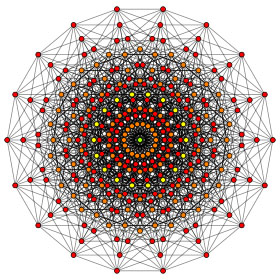
 Lugwig Schläfli is one of the three architects of multidimensional geometry, together with Arthur Cayley and Bernhard Riemann. Around 1850 the general concept of Euclidean space hadn't been developed — but linear equations in n variables were well-understood. In the 1840s William Rowan Hamilton had developed his quaternions and John T. Graves and Arthur Cayley the octonions. The latter two systems worked with bases of four (respectively eight) elements, and suggested an interpretation analogous to the cartesian coordinates in three-dimensional space.
From 1850 to 1852 Schläfli worked on his magnum opus, Theorie der vielfachen Kontinuität, (Treatise on the Theory of Multiple Continuity) in which he initiated the study of the linear geometry of n-dimensional space. He also defined the n-dimensional sphere and calculated its volume. He then wanted to have this work published. It was sent to the Akademie in Vienna, but was refused because of its size. Afterwards it was sent to Berlin, with the same result. After a long bureaucratic pause, Schläfli was asked in 1854 to write a shorter version, but this he understandably did not. Steiner then tried to help him getting the work published in Crelle's journal, but somehow things didn't work out. The exact reasons remain unknown. Portions of the work were published by Cayley in English in 1860. The first publication of the entire manuscript was only in 1901, after Schläfli's death. The first review of the book then appeared in the Dutch mathematical journal Nieuw Archief voor de Wiskunde in 1904, written by the Dutch mathematician Pieter Hendrik Schoute.
During this period, Riemann held his famous Habilitationsvortrag Über die Hypothesen welche der Geometrie zu Grunde liegen in 1854, and introduced the concept of an n-dimensional manifold. The concept of higher dimensional spaces was starting to flourish.
Below is a translation of an excerpt from the preface to Theorie der vielfachen Kontinuität, (Treatise on the Theory of Multiple Continuity): Lugwig Schläfli is one of the three architects of multidimensional geometry, together with Arthur Cayley and Bernhard Riemann. Around 1850 the general concept of Euclidean space hadn't been developed — but linear equations in n variables were well-understood. In the 1840s William Rowan Hamilton had developed his quaternions and John T. Graves and Arthur Cayley the octonions. The latter two systems worked with bases of four (respectively eight) elements, and suggested an interpretation analogous to the cartesian coordinates in three-dimensional space.
From 1850 to 1852 Schläfli worked on his magnum opus, Theorie der vielfachen Kontinuität, (Treatise on the Theory of Multiple Continuity) in which he initiated the study of the linear geometry of n-dimensional space. He also defined the n-dimensional sphere and calculated its volume. He then wanted to have this work published. It was sent to the Akademie in Vienna, but was refused because of its size. Afterwards it was sent to Berlin, with the same result. After a long bureaucratic pause, Schläfli was asked in 1854 to write a shorter version, but this he understandably did not. Steiner then tried to help him getting the work published in Crelle's journal, but somehow things didn't work out. The exact reasons remain unknown. Portions of the work were published by Cayley in English in 1860. The first publication of the entire manuscript was only in 1901, after Schläfli's death. The first review of the book then appeared in the Dutch mathematical journal Nieuw Archief voor de Wiskunde in 1904, written by the Dutch mathematician Pieter Hendrik Schoute.
During this period, Riemann held his famous Habilitationsvortrag Über die Hypothesen welche der Geometrie zu Grunde liegen in 1854, and introduced the concept of an n-dimensional manifold. The concept of higher dimensional spaces was starting to flourish.
Below is a translation of an excerpt from the preface to Theorie der vielfachen Kontinuität, (Treatise on the Theory of Multiple Continuity):
The treatise I have the honour of presenting to the Imperial Academy of Science here, is an attempt to found and develop a new branch of analysis that would, as it were, be a geometry of n dimensions, containing the geometry of the plane and space as special cases for n=2,3. I call this the theory of multiple continuity in generally the same sense, in which one can call the geometry of space that of triple continuity. Like in that theory the 'group' of values of its coordinates determines a point, so in this one a 'group' of given values of the n variables x,y,\ldots will determine a solution. I use this expression, because one also calls every sufficient 'group' of values thus in the case of one or more equations with many variables; the only thing unusual about this naming is, that I keep it when no equations between the variables is given whatsoever. In this case I call the total (set) of solutions the n-fold totality; whereas when 1,2,3,\ldots equations are given, the total of their solutions is called respectively (an) n-1-fold, n-2-fold, n-3-fold, … Continuum. From the notion of the solutions contained in a totality comes forth that of the independence of their relative positions (of the variables) in the system of variables used, insofar as new variables could take their place by transformation... - Ludwig Schläfli, Wikipedia
Theorie der vielfachen Kontinuität is available on Google books
 In geometry, the Schläfli symbol is a notation of the form {p,q,r,...} that defines regular polytopes and tessellations.The Schläfli symbol is a recursive description, starting with a p-sided regular polygon as {p}. For example, {3} is an equilateral triangle, {4} is a square and so on.
A regular polyhedron which has q regular p-gon faces around each vertex is represented by {p,q}. For example, the cube has 3 squares around each vertex and is represented by {4,3}.
A regular 4-polytope with r {p,q} regular polyhedral cells around each edge is represented by {p,q,r}, and so on.
Regular polytopes can have star polygon elements, like the pentagram, with symbol {5/2}, represented by the vertices of a pentagon but connected alternately.
A facet of a regular polytope {p,q,r,...,y,z} is {p,q,r,...,y}.
A regular polytope has a regular vertex figure. The vertex figure of a regular polytope {p,q,r,...y,z} is {q,r,...y,z}.
The Schläfli symbol can represent a finite convex polyhedron, an infinite tessellation of Euclidean space, or an infinite tessellation of hyperbolic space, depending on the angle defect of the construction. A positive angle defect allows the vertex figure to fold into a higher dimension and loops back into itself as a polytope. A zero angle defect will tessellate space of the same dimension as the facets. A negative angle defect can't exist in ordinary space, but can be constructed in hyperbolic space.
Usually a vertex figure is assumed to be a finite polytope, but can sometimes be considered a tessellation itself.
A regular polytope also has a dual polytope, represented by the Schläfli symbol elements in reverse order. A self-dual regular polytope will have a symmetric Schläfli symbol. - Schläfli symbol, Wikipedia In geometry, the Schläfli symbol is a notation of the form {p,q,r,...} that defines regular polytopes and tessellations.The Schläfli symbol is a recursive description, starting with a p-sided regular polygon as {p}. For example, {3} is an equilateral triangle, {4} is a square and so on.
A regular polyhedron which has q regular p-gon faces around each vertex is represented by {p,q}. For example, the cube has 3 squares around each vertex and is represented by {4,3}.
A regular 4-polytope with r {p,q} regular polyhedral cells around each edge is represented by {p,q,r}, and so on.
Regular polytopes can have star polygon elements, like the pentagram, with symbol {5/2}, represented by the vertices of a pentagon but connected alternately.
A facet of a regular polytope {p,q,r,...,y,z} is {p,q,r,...,y}.
A regular polytope has a regular vertex figure. The vertex figure of a regular polytope {p,q,r,...y,z} is {q,r,...y,z}.
The Schläfli symbol can represent a finite convex polyhedron, an infinite tessellation of Euclidean space, or an infinite tessellation of hyperbolic space, depending on the angle defect of the construction. A positive angle defect allows the vertex figure to fold into a higher dimension and loops back into itself as a polytope. A zero angle defect will tessellate space of the same dimension as the facets. A negative angle defect can't exist in ordinary space, but can be constructed in hyperbolic space.
Usually a vertex figure is assumed to be a finite polytope, but can sometimes be considered a tessellation itself.
A regular polytope also has a dual polytope, represented by the Schläfli symbol elements in reverse order. A self-dual regular polytope will have a symmetric Schläfli symbol. - Schläfli symbol, Wikipedia
|
